In this guide7 questions answered
No. SEO is not dead, but it is changing. People still search Google every day, and AI tools often build their answers from the same websites, listings and reviews that already do well in search. What has changed is what earns the click and the call.
Do people still search Google?
Yes, every day. ChatGPT and other AI tools have grown fast, but for most people they have added to search rather than replaced it. Many people now use both: an AI tool to think a problem through, then Google or Maps to find someone nearby, check reviews and call.
Local searches are where this matters most. When someone types "plumber near me" or "nail salon open now", they want a name, a phone number and directions. That still mostly happens on Google Search and Google Maps, and it still leads to calls.
Where do AI tools get their answers?
From the web, and largely from the same places search already looks. Google has said its AI Overviews and AI Mode use pages that are indexed and eligible for normal search, with no special extra requirements. OpenAI says public websites can appear in ChatGPT search as long as they do not block its search crawler. Microsoft Copilot leans on Bing.
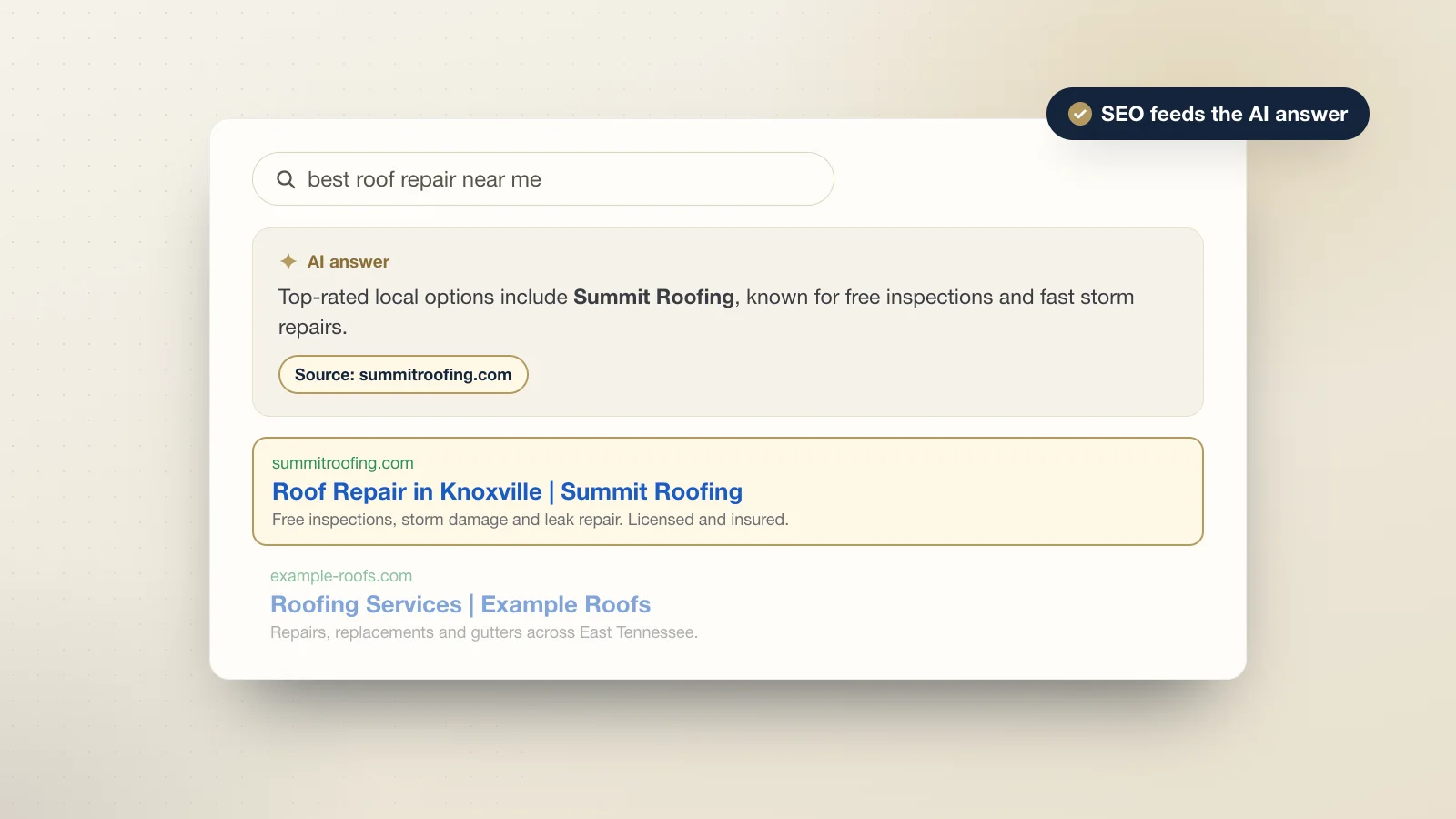
So when an AI tool answers "who is a good electrician in Franklin", it is reading websites, Google and Bing listings, reviews and local articles. A business that is strong in search and listings has a head start in AI answers too. A business that is hard to find on Google is usually hard for AI tools to find as well.
So what has actually changed?
- Fewer clicks on simple questions. When the answer appears right on the page, like "how long does a water heater last", many people read it and move on. Pages built only to answer quick questions get less traffic than they used to.
- Clear answers count for more. AI tools look for pages that state the answer plainly. Long, padded pages that bury the point are easy to skip.
- Trust counts for more. Reviews, a real address, a complete profile and consistent details help the tools decide you are a real business worth naming.
- Being cited is a new goal. It is no longer only about sitting at the top of a list. It is also about being one of the sources an AI tool names in its answer.
For most local businesses, this is less scary than it sounds. Someone looking up a quick fact was never likely to call you anyway. The people ready to book still want a phone number, real reviews and proof that you serve their area.
What still works?
A fast, clear website
Your site should load quickly on a phone, say what you do and where in the first screen, and make calling you easy. People and AI tools both need to read it, so keep key facts in real text, not in images.
Local SEO and Google Business Profile
A complete, verified Google Business Profile is still one of the best free tools a local business has. Add Bing Places and Apple Maps too. If your profile is stuck, read our guide to fixing "No more ways to verify".
Reviews
Reviews help you on Maps, help customers decide, and help AI tools judge your reputation. Ask every happy customer, and reply to every review, even the bad ones.
A page for each service and each town
One page for drain cleaning, one for water heaters, and one for each main town you serve. Each page should be useful on its own, with real details, not the same text with the town name swapped. Specific pages match specific questions, whether they are typed into Google or asked out loud to an AI tool.
What should a small business do now?
- Fix your listings first. Claim and complete Google Business Profile, Bing Places and Apple Maps. Make your name, address, phone and hours identical everywhere.
- Make your website answer real questions. Write down the ten questions customers ask most, and answer each one in plain words on the right page.
- Build one strong page per service and main town. Include prices or price ranges where you can, your service area and photos of real work.
- Ask for reviews every week. Make it a habit, not a one-time push. Send a direct review link after each job.
- Check yourself in AI tools once a month. Ask ChatGPT, Google and Copilot the questions your customers would ask. Note what they get right and wrong, then fix the source. Our post on getting recommended by ChatGPT and AI search covers what helps.
When should you stop paying for old-style SEO?
If your monthly SEO bill pays for any of these, it is time to ask hard questions:
- Keyword stuffing. Pages that repeat "best plumber Knoxville" over and over. They read badly to people and do nothing good for you with Google or AI tools.
- Cheap links. Hundreds of links from unrelated or spammy sites. Google has warned against link schemes for years, and they can do real harm.
- Mass AI articles. Dozens of generic blog posts a month that nobody reads. Google's spam policies target content churned out at scale mainly to rank, whether a person or a tool wrote it.
- Reports with no calls in them. If the report shows rankings for words nobody searches but never mentions calls, leads or your listings, you are paying for the wrong thing.
Good SEO today looks plainer: accurate listings, a clear site, steady reviews and useful pages. It should not cost a fortune, and you should be able to see it in calls and booked jobs.
So is SEO still worth paying for?
Yes, if it is the right kind. The tricks are dying, and the basics matter more now because AI tools lean on them too. Nobody can promise that Google or ChatGPT will show your business. The tools decide. What you can do is make your business the clearest, most trusted answer for the people near you.
Want help with that? Our Get found setup is $399 once and covers Google Business Profile, Apple and Bing Maps, SEO basics and AI search setup. Stay found is $149 a month for ongoing SEO, accurate listings and a monthly report. See SEO and AI search, or start with our free listing check.