In this guide6 questions answered
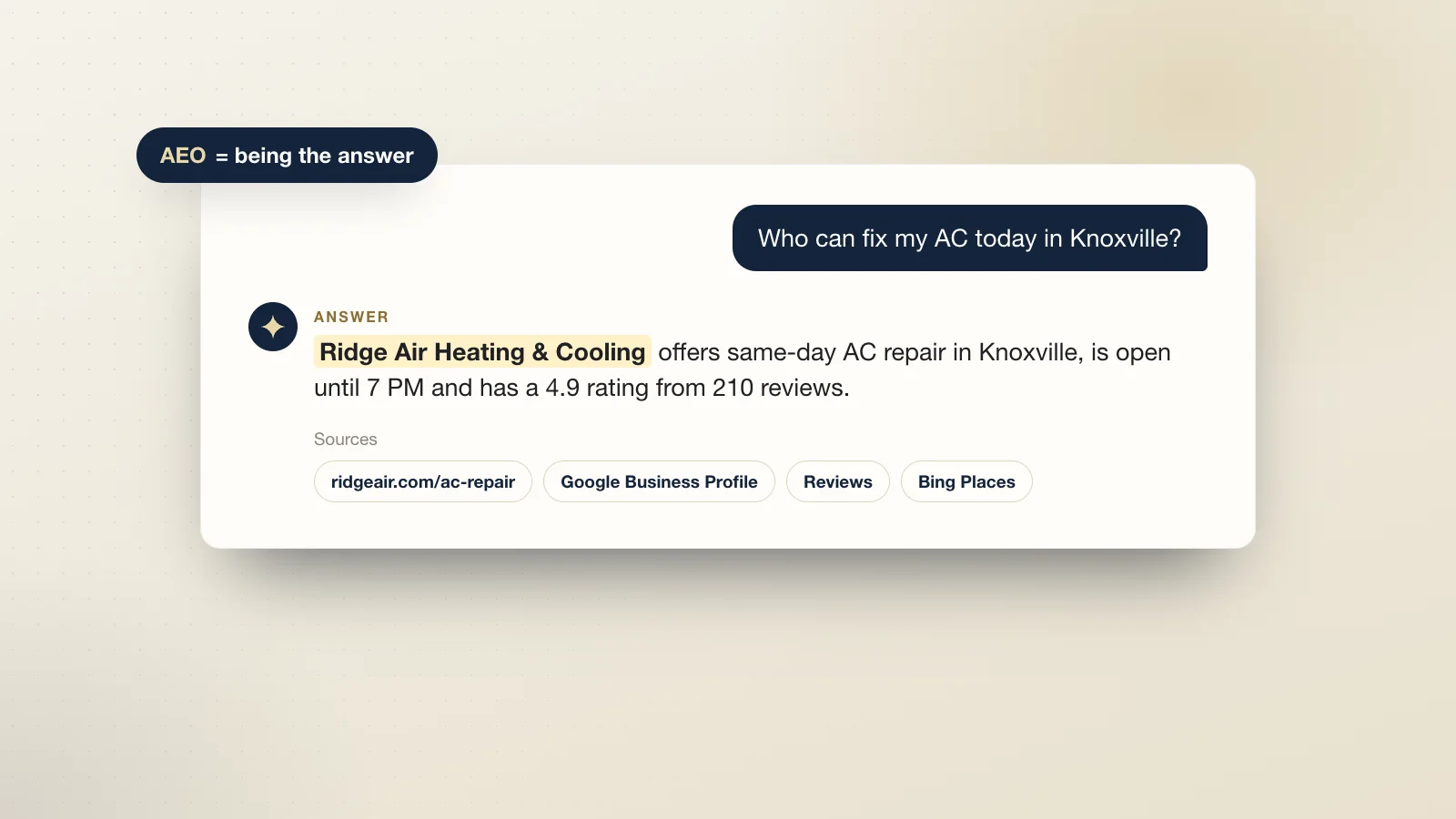
AEO stands for answer engine optimization. It means making your business easy for AI tools to understand and quote when someone asks them a question. It builds on SEO, it does not replace it, and most of the work is the same good basics done with more care.
What is an answer engine?
An answer engine is any tool that replies to a question with an answer instead of a list of links. Today that includes Google's AI Overviews and AI Mode, ChatGPT search, Microsoft Copilot, Perplexity, Claude and the voice assistants on phones and smart speakers.
Classic search gives you ten blue links and lets you pick. An answer engine reads a handful of sources, writes a short reply and sometimes names a few businesses. The person may never visit a website at all. If your business is not in that reply, you are not in the running for that customer.
Google has explained that AI Overviews and AI Mode can run several related searches behind the scenes to build one answer. So a question like "who fixes water heaters near me on a Sunday" can pull from many sources at once: service pages, listings, reviews and posted hours.
How is AEO different from SEO?
SEO is about ranking your pages so people click them. AEO is about being the source an AI tool picks when it writes its answer. The two overlap a lot. Google has said there are no extra requirements to appear in its AI features beyond what already makes a page eligible for normal search results. In other words, if your SEO is weak, your AEO will be weak too.
| SEO | AEO | |
|---|---|---|
| The goal | Rank your pages so people click through | Be the source an AI tool uses and names in its answer |
| Where it shows | Google and Bing results, Google Maps | AI Overviews, AI Mode, ChatGPT, Copilot, Perplexity, voice assistants |
| What helps most | Relevant pages, a fast site, good links | Direct answers, consistent facts, reviews, mentions on trusted sites |
| How pages are written | Built around the words people search | Questions in headings, short answers right below |
| How you measure it | Rankings, clicks and calls from search | Whether AI tools name you correctly, citations, calls and leads |
You will also hear the term GEO, short for generative engine optimization. It means roughly the same thing. Some people use GEO for tools like ChatGPT and AEO for direct answers and voice, but in practice the work is the same. Do not pay twice for two names.
What does AEO work look like for a local business?
We covered the basics in how to get your business recommended by ChatGPT and AI search. Here is what the work looks like in practice.
Write answers, not slogans
Take the questions customers ask you on the phone and answer them on your site in plain words. Put the question in a heading and the answer right under it, in the first sentence or two. "Do you offer emergency service? Yes, 24 hours a day, 7 days a week, across Knox County." That is easy for a person to read and easy for an AI tool to quote.
Add an FAQ page, and label it
A good FAQ page gathers your most common questions in one place. FAQ schema is a small piece of code that marks each question and answer for machines. Be aware that Google stopped showing FAQ rich results in its search pages in 2026, so the code will not get you a special listing on Google. The real value is the visible answers on the page. The code is a small extra on top.
Use LocalBusiness structured data
This is code that tells machines your business name, address, phone, hours, service area and what you do. Google still supports it for local businesses. It must match what people can see on the page.
Keep your name, address and phone the same everywhere
AI tools compare sources. If your website shows one phone number, Google shows another and Yelp has an old address, the tools get less sure about you. Pick one version of your details and use it on every listing.
Complete Google Business Profile and Bing Places
Your Google Business Profile feeds Google Maps and Google's AI answers. Bing Places matters because Microsoft Copilot leans on Bing. Fill in every section: categories, services, hours, photos and a real description. If your Google profile is stuck in verification, see our guide to the "No more ways to verify" message.
Ask for reviews, steadily
Reviews are one of the main ways AI tools judge whether people trust you. Ask every happy customer, and reply to reviews, good and bad. A steady flow beats a burst of twenty in one week.
Get mentioned on trusted sites
Local news, your chamber of commerce, trade associations, supplier pages and well-known directories all count. When several trusted sites describe you the same way, AI tools have more reason to name you.
Keep pages fast and easy to read
Put important facts in real text, not inside images or PDFs. Keep pages quick to load on a phone. Make sure your site does not block search crawlers. A tool that cannot read your page cannot quote it.
An llms.txt file, if you like
An llms.txt file is a short plain-text summary of your site written for AI tools. Some tools may read it. Google has said you do not need special AI files to appear in its AI features, so treat it as an optional extra, never the main job.
How do you know if AEO is working?
The simplest test is free. Open ChatGPT, Google, Copilot and Perplexity and ask the questions your customers would ask. Not your business name, but the real question: "good family dentist in Maryville" or "who can replace a garage door spring today near me".
- Do you appear, and is your information correct?
- Which other businesses get named, and what do their websites and reviews have that yours does not?
- Does the tool get your hours, services or service area wrong? That points to a mismatch somewhere online.
Answers change from day to day and from person to person, so test a few times over a few weeks, not once. Google Search Console counts visits from AI Overviews and AI Mode in its normal performance report, and Bing Webmaster Tools now has a report showing when your pages are cited in Copilot answers. Calls and form leads are still the best measure.
What AEO mistakes should you avoid?
- Treating AEO as a replacement for SEO. AI tools lean on pages that already do well in search. Skip the basics and nothing else will help much.
- Publishing piles of AI-written articles. Thin, copied pages do not make you a trusted source. A few clear pages written from real experience do more.
- Hiding answers. Prices "on request", hours only in a photo, services only in a PDF. If a customer cannot find it fast, neither can a tool.
- Fake reviews or keyword stuffing. These can get a profile suspended, and they make your business harder to trust.
- Paying for promises. Nobody controls what an AI tool says. The tools decide. Anyone promising you a spot in ChatGPT's answers is guessing.
- Setting it and forgetting it. Hours change, services change, and old details spread. Check your listings every few months.
Where should a small business start?
Start with your Google Business Profile, your Bing Places listing and the five questions customers ask you most. Answer those on your website in plain words. That alone puts you ahead of many local competitors.
Rather have it done for you? Our $399 Get found setup covers Google Business Profile, Apple and Bing Maps, SEO basics and AI search setup, paid once. Stay found is $149 a month if you want us to keep your listings accurate and keep working on SEO, with a report every month. Start with a free listing check, or see SEO and AI search.