In this guide11 questions answered
- What is local SEO, in plain words?
- How does Google decide who shows up on the map?
- What matters most for a small business?
- What else helps?
- What does not work anymore?
- A simple local SEO plan you can follow
- What if I go to my customers instead of them coming to me?
- How do I know if local SEO is working?
- How long does local SEO take?
- Can I do local SEO myself?
- How much does local SEO cost?
Local SEO is the work that helps your business show up when someone nearby searches for what you do, like "dentist near me" or "roof repair in Franklin". Google decides who to show based on three things: how well you match the search, how close you are to the person searching, and how well known and trusted your business is. Local SEO is everything you do to improve the first and the third, since you cannot move your shop.
What is local SEO, in plain words?
Regular SEO helps a website show up in search anywhere. Local SEO is about showing up for people in your area, mostly in three places:
- The map results. The box with a map and three businesses at the top of many searches, often called the local pack, and Google Maps itself.
- The regular results under it. Your website ranking for searches like "electrician Brentwood TN".
- AI answers. Google's AI Overviews, ChatGPT, Copilot and others, which increasingly name a few local businesses when people ask for a recommendation.
All three draw on the same building blocks: your Google Business Profile, your website, your reviews and your details on other sites.
How does Google decide who shows up on the map?
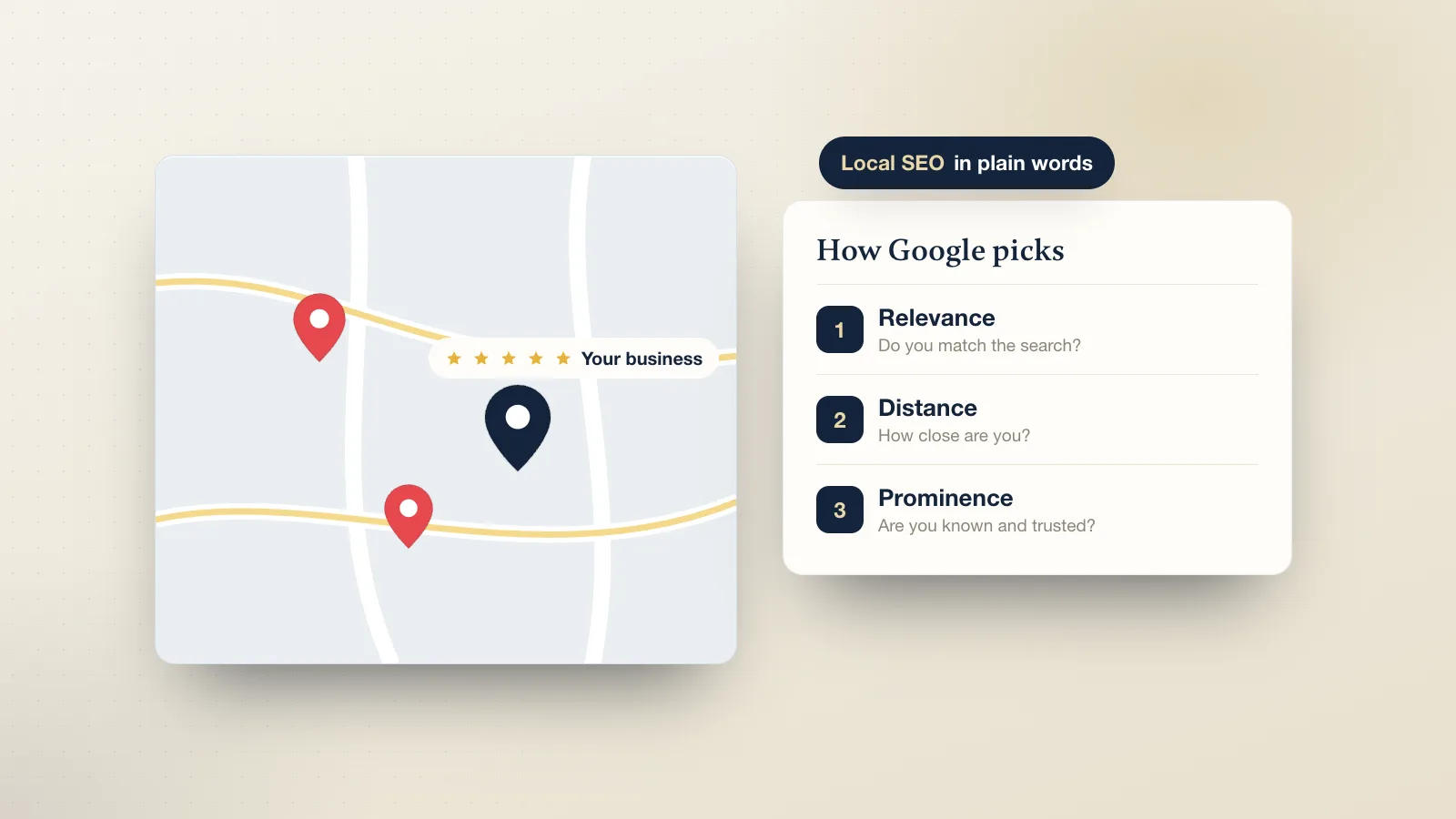
Google says local results are based mainly on three factors.
Relevance
How well your business matches what the person searched. If someone searches "emergency plumber" and your profile and website clearly say you do emergency plumbing, you are relevant. If they only say "plumbing services", you are less so. This is where categories, services and clear website pages matter.
Distance
How far you are from the person searching, or from the town they named. You cannot change this, which is why a business slightly farther away can still win with a stronger profile. It is also why you may show up well near your shop and poorly 15 miles away.
Prominence
How well known and trusted your business is. Google looks at reviews (how many, how recent, how good), links and mentions on other websites, and how your website does in regular search. Google says a business's position in web results also counts toward local ranking, so your website and your map listing help each other.
What matters most for a small business?
Hundreds of small things can help, but for most local businesses, three do most of the work.
1. A complete, accurate Google Business Profile
This is the single most important free tool you have. A strong profile has:
- The right main category, plus any extra categories that truly fit. The main category matters a lot.
- Your real business name, with no extra keywords added. Adding words like "Best Plumber Nashville" to the name breaks Google's rules and can get the profile suspended.
- Accurate hours, including holiday hours.
- Your services, each with a short description.
- Real photos of your work, your team, your vehicles or your storefront.
- A link to the right page on your website.
If your profile is not verified yet, start there. Our guides cover fixing "No more ways to verify" and a profile that does not show up.
2. Reviews, steadily
Reviews help in three ways at once. They help you on the map, they help customers choose you, and they give AI tools a reason to trust you. What counts is not only the star rating but also how many reviews you have and how recent they are. Ten reviews from three years ago look weaker than ten from the last few months.
Ask every happy customer, every time. Send a direct review link by text after the job. Reply to every review, good and bad, in a calm and helpful way. Never pay for reviews or offer discounts in return for them. Google does not allow it.
3. A website that says what you do and where
Your website gives Google and AI tools the detail your profile cannot hold. A strong local website has:
- Your service and town on the first screen, in real text.
- A page for each main service, with real details, prices or price ranges where you can, and the questions customers ask.
- A page for each main town you serve, but only if you can say something useful and different about each one. The same text with the town name swapped does not help.
- Your name, address and phone number in the footer, matching your Google profile exactly.
- Fast loading on a phone, and an easy tap-to-call button.
What else helps?
Consistent details everywhere
Your business name, address and phone number should be the same on your website, Google, Bing Places, Apple Maps, Yelp, Facebook and any industry sites. Small differences, like an old suite number or a different phone number, make it harder for Google and AI tools to be sure all these listings are the same business.
Bing and Apple Maps
Many phones use Apple Maps by default, and Microsoft Copilot leans on Bing. Both are free to claim and take little upkeep once set up. Our guide to getting on Google Maps covers the basics that apply to all three.
Local links and mentions
A mention on your chamber of commerce site, a local news story, a sponsor page for a youth sports team, or a supplier's list of installers all help show you are a real, known local business. A few genuine local links are worth more than hundreds of random ones. Paying for bulk links can hurt you.
Photos and posts
Fresh photos and the occasional Google post show the profile is active. They are not magic, but they help customers trust what they see, which leads to more calls.
What does not work anymore?
- Keyword stuffing. Repeating "best roofer Knoxville" across a page reads badly and does not help.
- Fake addresses. Virtual offices or mailbox stores used to look local in another town. Google treats these as a guideline violation, and they are a common reason for suspensions.
- Bought reviews. Google filters and removes them, and they can lead to a warning on your profile.
- Hundreds of near-identical town pages. Google's spam rules target pages made at scale mainly to rank.
A simple local SEO plan you can follow
- Week 1: Google Business Profile. Claim or verify it, choose the right main category, fill in every field, add 10 or more real photos.
- Week 1: Bing Places and Apple Maps. Claim both. Bing can import from your Google profile.
- Week 2: Fix your details everywhere. Search your business name and old phone numbers. Update Yelp, Facebook and industry sites so everything matches.
- Week 2: Your website's first screen and footer. Service and town up top, name, address and phone at the bottom.
- Weeks 3 and 4: Service pages. One clear page for each main service, with prices or ranges and real questions answered.
- Every week after: Reviews. Ask after every job. Reply to every review.
- Every month: Check. Search your main services from a phone in a few nearby spots. Ask ChatGPT and Google who they recommend. Update photos and hours.
What if I go to my customers instead of them coming to me?
Plumbers, cleaners, landscapers, mobile mechanics and other trades that work at the customer's place are called service area businesses. Local SEO works for you too, with a few differences:
- Hide your address on Google. Set your Google Business Profile up as a service area business and list the towns or areas you cover. Google still knows where you are based.
- Keep your service area realistic. Google tends to show you most near where you are based, so listing towns two hours away rarely helps.
- Let your website do the reaching. A useful page for each main town you serve, with real jobs, photos and local details, helps you show up in those towns in regular results, even when the map favors closer businesses.
- Show proof you work there. Photos of jobs in each area, reviews that mention the town, and local mentions all help.
How do I know if local SEO is working?
Do not judge it by one search on your own phone. Google personalizes results, and your phone is often right next to your shop. Use these instead:
- Google Business Profile performance. Your profile shows how many people found you, how many called, asked for directions or visited your website. Compare month to month.
- Calls and bookings. The number that matters. Ask new customers how they found you and write it down.
- Search Console. Google's free tool shows which searches bring people to your website and how often you appear.
- Spot checks from different places. Search your main services from a few spots around your area, or ask a friend across town to look.
- AI answers. Once a month, ask ChatGPT and Google who they recommend for your service in your town. Our guide to checking if ChatGPT recommends your business shows how.
Rankings for words nobody searches mean little. If a report shows a lot of numbers but never mentions calls, directions or bookings, ask for those.
How long does local SEO take?
Fixes to your listings, like the right category or correct hours, can show up within days or weeks once Google picks them up. Steady gains in the map results usually take a few months, because reviews and trust build over time. How long it takes depends a lot on your area. A plumber in a small town may move up quickly, while a lawyer in a big city faces much tougher competition. Anyone who gives you an exact date or promises the top spot is guessing.
Can I do local SEO myself?
Yes. Everything in the plan above can be done by an owner with a few hours a week. The hard parts are knowing which settings matter, avoiding moves that trigger a suspension, and keeping it going once things get busy. That is where most owners decide to get help.
How much does local SEO cost?
Prices vary a lot. Some agencies charge several hundred to a few thousand dollars a month. For many small businesses, the biggest gains come from getting the basics set up properly once, then keeping them up. Our Get found setup is $399 once and covers your Google Business Profile, Apple and Bing Maps, SEO basics on your website and AI search setup. Stay found is $149 a month for ongoing SEO, accurate listings and a monthly report. If your profile is stuck or suspended, our Google Profile Rescue is $399 once.
Want to see where you stand first? Our free listing check looks at your Google, Bing and Apple listings and your website basics, with no call needed. Or see SEO and AI search for the full details.